

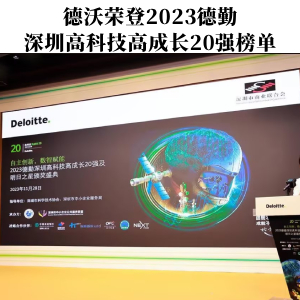
Devol has been listed on Deloitte Shenzhen's 2023 High-Growth Technology 20 list
更多The chip industry is once again in turmoil, and a fierce battle without gunsmoke has begun!
News 发布于 2022-08-16On August 9, 2022, US President Joe Biden signed the Chips and Science Act worth a total of 280 billion US dollars at the White House, planning to provide 52.7 billion US dollars in government subsidies. The Global Times reported that in the relevant statement released by the White House of the United States, the purpose of the "Chips Act" was summarized as reducing costs, creating jobs, strengthening supply chains and countering China.
Support American chips
The core of the "Chips Act" lies in helping the United States regain its leading position in the field of semiconductor manufacturing. Industry data shows that the share of the United States in the global semiconductor manufacturing industry dropped from 37% in 1990 to 12% in 2020. During the same period, China's share in this field rose from 2% to 16%.
First, it will provide 52.7 billion US dollars for semiconductor research and development, manufacturing and labor force development in the United States: including an investment of 39 billion US dollars within five years to encourage semiconductor manufacturing enterprises to set up factories in the United States; Provide 11 billion US dollars within five years to promote research and development in advanced semiconductor manufacturing and expand workforce training opportunities. In addition, enterprises that set up factories in the United States will enjoy a 25% tax credit.
Second, over 170 billion US dollars will be allocated within five years to authorize institutions such as the National Science Foundation of the United States and the Department of Commerce to increase investment in scientific research and development in key areas, promoting scientific research in the United States.
One of the most notable provisions of the "Chips Act" is that companies receiving federal funds are prohibited from significantly increasing the production of advanced process chips in China for a period of 10 years. Companies that violate the ban or fail to correct their violations may be required to fully refund the federal subsidies. A research report released by Huatai Securities stated that currently, companies with semiconductor factories in both China and the United States include TSMC (Nanjing), Samsung (Xi 'an), and Hynix (Dalian). If these companies accept subsidies under the "Chip Act", they may be restricted from building or expanding advanced process wafer fabrication plants in China.
The United States is closing in step by step
To support the introduction of the "Chip Act", the United States has been taking continuous sanctions against China's semiconductor industry. Right after the "Chip Act" was implemented, the United States announced a ban on the sale of equipment for manufacturing 14nm or more advanced processes to China and a notice to cut off the supply of EOM software to China. Along with the recent investigation of several senior executives in the domestic chip industry, The chip industry is beset with frequent internal and external troubles and uncertainties. It is well known that the development of the semiconductor industry benefits from the system of global division of labor. The United States' suppression of China is under the guise of "competition", but in fact, it is exercising the measure of "curbing fair competition", which is bound to affect the normal development of the global semiconductor industry chain.
With proactive responses, domestic substitution is expected to accelerate
Semiconductors are a key strategic industry for a country's economy and national security. Under the influence of multiple factors such as major power competition, trade wars, and the global pandemic, it is necessary to improve the integrity and independent controllability of the domestic supply chain and strengthen the security of the chip supply chain. From a positive perspective, the implementation of the US chip bill might present both an important opportunity and a significant challenge for China's semiconductor industry.
In recent years, with the rapid growth of domestic packaging and testing enterprises, Chinese manufacturers have also gained international competitiveness in packaging and testing technology. Semiconductor packaging involves a series of processes such as cutting, dicing, mounting, wire bonding, packaging, electroplating, forming, final testing, and packaging of the fabricated wafers. In terms of the wire bonding process in chip packaging, to achieve an electrical connection between the chip and the substrate, the wire bonding machine, the most core equipment in chip packaging, is indispensable. The quality of wire bonding directly affects the performance and reliability of the entire packaged device.
To further meet the demands of high-precision and high-stability wire bonding processes, Dewo Advanced has overcome key technological challenges. Based on its proprietary core technologies such as an integrated trajectory ultra-high-speed synchronous motion control system, an independent vision algorithm, ultra-high-speed motor and drive algorithms, a precise ultrasonic ignition system, and high-speed synchronous coordination algorithms among various systems, it has launched a high-precision fully automatic wire bonding machine. Combining the wire bonding process can stably apply to the mainstream wire materials and wire diameters in the market. It can be applied to various packaging forms in integrated circuit packaging, while also meeting the market requirements for small electrodes, multiple pins, large spans, multi-row lead bonding, various types of wire arcs, and stacked wire arc process technologies. It can significantly and effectively improve the consistency and stability of lead bonding. Semiconductor technology equipment plays an amplifying and supporting role in the semiconductor manufacturing industry, solving the "bottleneck" problems. Dewo Advanced helps domestic substitution in the semiconductor packaging wire bonding process.
Semiconductors have become the focus of technological competition among countries. In such a complex and severe international situation, looking back at every technological transformation in China, which one has not been a comeback from a desperate situation? So the future of the industry is promising. Let's wait and see!
相关文章

新闻分类
近期新闻
- Devol has been listed on Deloitte Shenzhen's 2023 High-Growth Technology 20 list 2023-11-29
- Good News | Devol Advanced has been approved for funding as a key project of the "Challenge and Response" technology research and development program by the Shenzhen Science and Technology Innovation Commission 2022-04-15
- DAA won the Best Brand Enterprise Award for China's Semiconductor Packaging and Testing Equipment 2026-04-13
- SEMICON CHINA 2026 2026-04-13
- CSPT2024| Highlights Review 2024-10-09