

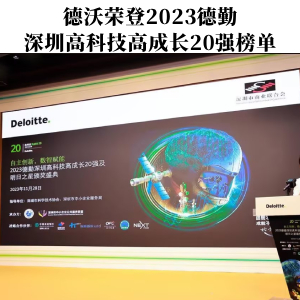
Devol has been listed on Deloitte Shenzhen's 2023 High-Growth Technology 20 list
更多1 Introduction
MEMS as the forefront of high-tech in the 21st century, in the industrialization of the road has been developed for more than 20 years, today, MEMS products because of its mass production, low cost and high performance and other characteristics, has a large market, most of the early packaging technology is borrowed from the semiconductor integrated IC field of ready-made packaging process, MEMS products. Due to the differences in the range of use and application environment of various products, their packaging does not have a unified form [1], and appropriate packaging should be selected according to the specific use situation. At the same time, in the manufacturing process of MEMS products, packaging can only be carried out individually and cannot be produced in large quantities at the same time, so packaging accounts for 70%-80% of the total cost of MEMS products. Packaging technology has become the bottleneck in MEMS production. CSP and WLP packaging are the main ways of MEMS mass production and miniaturization.
2 Challenges of MEMS packaging [2-4]
Current MEMS packaging technology is mostly developed and evolved from integrated circuit packaging technology, but due to the complexity of its application environment, it has great particularity compared with integrated circuit packaging [5], and it cannot simply package integrated circuit packaging directly to package MEMS devices.
Similar to IC packaging, MEMS packaging mainly realizes three functions: mechanical support, environmental protection, and electrical connection [6].
2.1 Mechanical Support
Some MEMS chips have cavities, and some have suspended beams. The size of these micromechanical structures is very small, the strength is very low, and it is easy to be damaged by mechanical contact and contaminated by exposure. Especially single-sided devices are processed in bulk on very thin films, and the strength of the structure is even lower. Higher requirements are put forward for the mechanical properties of the package.
2.2 Environmental Protection
On the one hand, MEMS packaging needs to protect the microstructure, circuits and electrical connections to ensure the stability and reliability of the system: On the other hand, it is necessary to provide one or more environmental interfaces for the sensor chip, so that it can fully perceive the change of the physical quantity to be measured. From the signal interface, the input signal interface of MEMS is complex, which may be optical signals (photodetectors), magnetic signals (magnetic sensitive devices), and magnetic signals. As well as the size of the mechanical force (pressure sensor), the level of the temperature (temperature sensor), the composition of the gas (sensitive gas detector), etc., this complex signal interface brings great difficulty to the package.
2.3 Electrical Connection [7]
Electrical connection refers not only to the signal connection between the MEMS device and the upper level system (including providing power and ground connections to the chip), but also to the signal path connection inside the MEMS device. When a MEMS device is integrated with a circuit, the signal distribution and power distribution of the system need to be considered.
In addition, in the actual MEMS package, it must consider the following factors, first of all, the package must bring the stress to the sensor as small as possible, the coefficient of thermal expansion (CTE) of the material must be similar to the thermal expansion coefficient of silicon or slightly larger, due to the mismatch of the material, it is easy to lead to interface stress, so that the chip rupture or delamination. For the stress sensor, the impact of the stress caused by the package on the device performance must be considered in the design, secondly, for the general MEMS structure and circuit packaging, heat dissipation must be given full attention, the possibility of device failure at high temperatures will be greatly increased, and for the heat flow meter and infrared sensor, appropriate thermal isolation will improve the sensitivity of the sensor. Thirdly, for some special sensors and actuators, the air tightness of the package needs to be considered, and the air tightness and leakage of the package are crucial to improve the accuracy and service life of the pressure sensor. For some sensors with moving parts, vacuum packaging can avoid the air damping of the vibration structure and improve the service life. Finally, because the output signal of MEMS sensors is micro and nano, the parasitic effect of packaging on the device must be considered.
3 Advanced MEMS packaging technology [8-10]
Traditional MEMS packaging is mainly metal packaging, ceramic packaging and plastic packaging in three forms, metal packaging and ceramic packaging because of its good thermal conductivity, good air tightness and other advantages in the packaging of some individual devices often used, casting plastic due to the sealing performance is not good enough, and limits the application of plastic packaging in some areas with high sealing performance requirements, at present, The research results of getter give a new opportunity for the application of plastic packaging in MEMS. Getter can be used to remove moisture and other particles inside MEMS devices that will affect the reliability of the device, and the use of appropriate getter and plastic packaging technology can obtain a quasi-sealed package effect, thereby reducing the cost of packaging and ensuring the reliability of MEMS devices.
In recent years, MEMS packaging technology has made great progress, there are many MEMS packaging technology, most of the research is focused on the special application of different packaging processes, but some of the more general, more perfect packaging design has been developed, although it is difficult to distinguish the subtle differences between different packaging methods, but usually can be divided into three basic packaging levels: (1) chip-level packaging; (2) wafer level package; (3) System-level packaging [11].
3.1 Chip-level package
With the development of MEMS systems of integrated IC circuits, the area of MEMS chips is getting larger and larger, and more and more pins are being used, making the original Package form no longer suitable, and the emergence of Chip size package CSP (Chip Scale Package) has finally solved the contradiction between small chip and large package for a long time.
Chip size package refers to the chip package area is not greater than 120% of the chip area, or the chip package is not greater than 1mm on each side of the product, there are many types of CSP. There are flexible package CSP (FPBGA), rigid substrate CSP (CSTP), lead frame CSP (LOC type CSP), grid array lead type CSP (LGA type CSP) and micro-molded CSP, etc. Different CSP structures, their technologies are not the same, but they are based on two fundamental technologies: Inverted mount welding (FCB) and ball grid array (BGA).
3.1.1 Reverse welding technology [12,13]
Flip Chip technology originated from IBM's C4 technology (Controlled Collapse Chip Connection), which is an advanced packaging technology that connects the chip directly to the substrate. In the packaging process, the chip in a face-down way to make the joint points on the chip through the metal conductor and the joint points of the substrate are connected to each other packaging technology, and compared with the traditional lead bonding technology, the use of flip chip technology, the pin can be placed anywhere directly below the chip, rather than only arranged around it. In this way, lead inductance becomes smaller, crosstalk becomes weaker, signal transmission time is shortened, and electrical performance is improved. At the same time, because the flip chip technology can directly cover the chip on the substrate, the size of the package can be reduced by the chief officer, and the chip size package (CSP) can be realized.
There are three electrical connection methods in the back-up welding technology: Solder bump method, thermocompression welding method (and thermoultrasonic welding method) (see Figure 1), and conductive adhesive bonding method (see Figure 2). No matter what kind of electrical connection, the production of convex points is very critical. The salient points are divided into soft salient points (solder metal) and hard salient points (Au or Cu) according to the different components, and are divided into spherical salient points and columnar salient points according to the shape, and columnar salient points can achieve bar distance, and the gap is adjustable. [14, 15] Ball bump method is the most commonly used FC technology in IC, the process is mature and the cost is low. It uses soft bump welding, Reflow welding to achieve bump welding, and finally Underfill process, hot pressure welding (and thermoultrasonic welding) uses hard bump welding, welding by heating pressure or ultrasonic method, and finally uses Underfill process to relieve thermal stress mismatch. There are two kinds of conductive adhesive bonding methods: each conductive adhesive and isotropic conductive adhesive. The anisotropic conductive adhesive is applied between the entire void and conducts electricity only in the vertical direction, which can achieve the Fine pitch process. The isotropic conductive adhesive is only added between the contact points, and an epoxy resin slurry containing silver particles is generally used.
相关文章
新闻分类
近期新闻
- Devol has been listed on Deloitte Shenzhen's 2023 High-Growth Technology 20 list 2023-11-29
- Good News | Devol Advanced has been approved for funding as a key project of the "Challenge and Response" technology research and development program by the Shenzhen Science and Technology Innovation Commission 2022-04-15
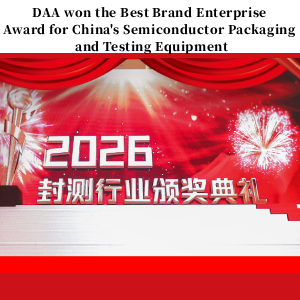
- DAA won the Best Brand Enterprise Award for China's Semiconductor Packaging and Testing Equipment 2026-04-13
- SEMICON CHINA 2026 2026-04-13
- CSPT2024| Highlights Review 2024-10-09